I arrived at the exhibition of Ice Age Art in the British Museum full of doubt.
I wanted to hear voices from far away, from down the long millennia; but I was afraid the ancient sculptures would be dumb and stiff and dead.
What did I see?
I saw the delicate step of a questing deer, the fierce low-thrust head of a goose, the arched neck of a proud horse, the massive threat of a bison's shoulders...
...and more, and more...
...the stillness and contemplative fragility of women huge with child; the smugness of a well-fed lion; the wide-eyed anxiety of a swimming reindeer.
Perhaps these things come from a time when all art was true. When all art was beautiful, honest, and yet still full of secrets.
Imagine a blade of flint perhaps 20 cm long but only 0.6 cm deep at its thickest part. Imagine the delicacy of it.
Imagine a flute made of a hollow bone, and then imagine music and singing and dancing.
Imagine a people 40,000 years away and yet close enough to feel their breath on your cheek.
*************************************************************
On the way out of the museum we came across a table of treasures the public was allowed to hold. There was a Greek vase made 2,400 years ago; a piece of cuneiform writing (the oldest writing in the world) incised on clay; and a flint hand axe.
The axe was 350,000 years old.
350,000 years. Older than my species, then. Far older. It came from the time of the Neanderthals.
And, oh, but it was a fine thing, carefully made and effective.
Once more, the millennia melted away.
*******************************************************
It's been an honour and a privelege to be able to spend a year in the company of Neanderthal man, but now it's time for me to make my way back to the present, to Homo sapiens and the world we've made for ourselves.
Many thanks to everyone who's visited this blog (especially to Adele Geras, who has made this blog immeasurably more interesting). I hope the story of our brother human beings has proved rewarding.
I may post the occasional update here, but from now on I shall be blogging chiefly at The Word Den. Further news about Song Hunter will be available from time to time at www.sallyprue.co.uk.
May the world turn dazzlingly about you, and may you find a thousand songs of your own to sing,
Sally Prue
SONG HUNTER by Sally Prue. Oxford, 2013.

Sunday, 17 February 2013

Saturday, 16 February 2013
The art of the Neanderthals.
Waiting for a book to be published always seems to take a
long time, and the wait for SONG HUNTER to make it into print has been both
long and anxious.
A great deal of research is going on all the time. At any
moment – at any moment - someone might come up with a discovery which
blows the principle behind SONG HUNTER clear out of the water.
And sure enough...
The thing is, a shell has been found in Spain. It does
genuinely seem to have been used to mix up pigments, and it genuinely does have a hole in
it as if for a pendant.
So, can this be a sign that the Neanderthals had art after all?
Well, yes, it can,
but it doesn’t necessarily mean it must.
Even if the hole was made on purpose then it might have been used to make carrying the shell easier, rather than as a decoration (my measuring spoons are tied together,
for instance, but I don’t wear them to parties).
As for the pigment (by which is meant ground-up rock or
crumbled clay), yes this can be, and is still, used for painting; but it makes
rather a good anti-insect coating for hides, too.
But I’m still on tenterhooks, here, you know.
Friday, 15 February 2013
The arrival of the modern mind.
I'm off to the Ice Age Art exhibition today. It's entitled The arrival of the modern mind, and this is exactly what Song Hunter is all about.
I shall see a lion headed figure like this:
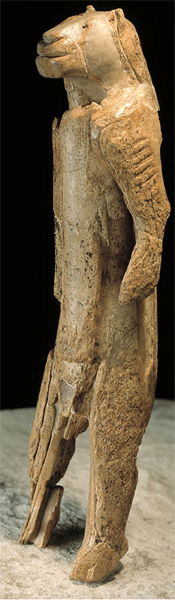
which was made while there were still Neanderthals living in Europe.
I'm longing to find out if it still has anything to say to me, or whether its power is dead and gone.
Report here on Sunday.
I shall see a lion headed figure like this:
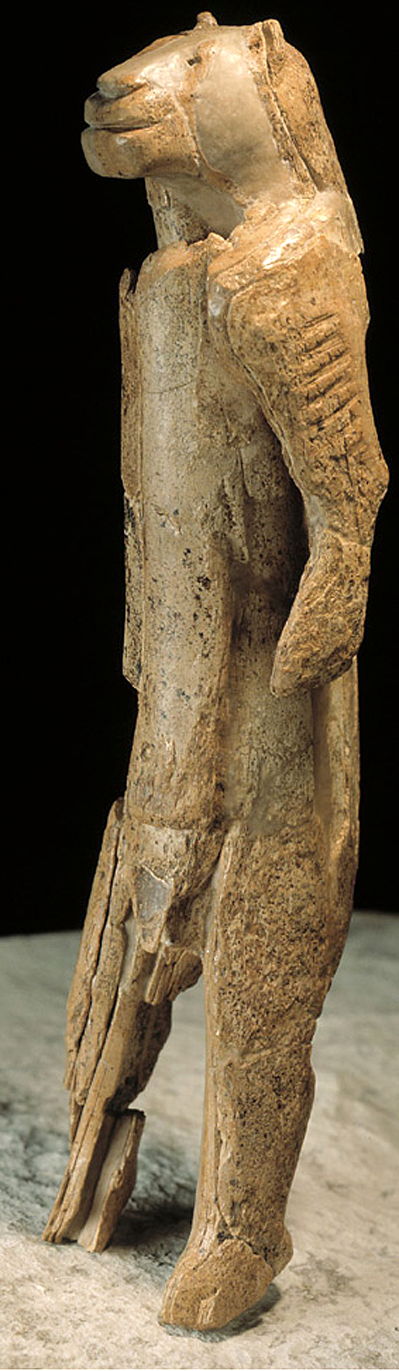
which was made while there were still Neanderthals living in Europe.
I'm longing to find out if it still has anything to say to me, or whether its power is dead and gone.
Report here on Sunday.
Thursday, 14 February 2013
Hot love?
The science says that modern humans got together with Neanderthals to have children.
Whether they loved each other is harder to prove until we comes across some
gariffiti.
But if you're doubtful about the possibility, try watching this:
Whether they loved each other is harder to prove until we comes across some
Humy Loves Neand
gariffiti.
But if you're doubtful about the possibility, try watching this:
Makes you feel warm all over, doesn't it?
Hm...that's probably a no, isn't it.
Wednesday, 13 February 2013
A real man?
A real man?
Scientists aren’t in agreement about much to do with Neanderthals. They’re still even arguing about whether Neanderthals are the same species as modern man: whether they should be called Homo sapiens neanderthalis, or, if they're a different species altogether, Homo neanderthalis.
What do I think myself? Well, all I can say is that I feel more sympathy with the Neanderthals of SONG HUNTER than with a lot of people I’ve met; and that personally I’d be charmed and honoured to discover I have a Neanderthal many-greats granny and grandad whose brains were bigger than those of most modern humans and who could do useful and splendid things like making knives from flint, making fur coats from dead animals, and staying alive in a very very cold climate.
Monday, 11 February 2013
An evolutionary dead-end.
An evolutionary dead-end, Neanderthals, weren't they.
Do you think our own species will manage to break the Neanderthals’ record?
Sunday, 10 February 2013
Vole clocks.
Vole clocks?
Oh, vole clocks are like moustache ukuleles.
Well, okay, they’re only like moustache ukuleles in that they remind me I’m living
in an infinitely wonderful world.
( A moustache ukulele is a ukulele with educational pictures of various different
types of moustache painted all over it.)
Vole clocks are used by archaeologists to date remains.
Voles have evolved at a nice steady rate, and by looking at the teeth of the
voles which are buried at the same level as the remains you can tell how old
everything is.
And I say to myself...
Subscribe to:
Comments (Atom)